On taming the animal within
A perfectionist's struggle to find perfection in meditation
I just received a newsletter from a fellow business owner. She does not consider herself a writer, but she's quite gifted. Her weekly notes are more like gentle love letters for her clientele - every one of them more vulnerable and heartfelt than the week before.
Her latest email was around the topic of being "still": less about her ability to do so and more around her inability to do so.
She wants to incorporate more "stillness" into her life. More mindfulness.
She questions when she could fit it all in? She currently owns a successful business, she is the mother of three children (two teens) and the wife of an adoring yet equally busy husband. Her salon is always bustling. Add a couple pets to the mix, her life looks more like a zany 80's sitcom than one of serenity.
Stillness is the gift she gives to her clients in her salon. Yet, she cannot find any for herself.
All peak performers can relate to this.
Every one of us faces some kind of pressure to deliver for others. We face this pressure throughout our lives - first as children, then as students, later as employees, parents and even as lovers.
Somehow this pressure has now crossed over into our own personal wellness.
Fitness trackers buzzing and vibrating telling you, "not enough steps". Sleep trackers telling you "not enough sleep". Fitness classes telling you "not enough intensity".
How many more ways can we be told we aren't doing enough even when it comes to ourselves?
Enough of 'enough'
The truth is simple: YOU have always been enough.
But there are industries who profit greatly on our never feeling that way. Big industries who prey on every insecurity you or I can ever have. Corporations that move the goalposts on beauty, fitness, and success all for the sake for quarterly dividends. Media conglomerates that proliferate the ever-changing 'standards' of perfection.
Their methods are insidious.
Nineteen year old social media influencers post "GRWM, try on haul" videos showing you a shipment of luxury clothes or makeup. Reduced calorie alcohol commercials showing you all of the attractive people holding candy-colored cocktails with their gorgeous friends. Medical spas showing you with just an injection or two that even you can turn back the time.
The list is endless.
The greater truth is that social media influencers do not actually purchase the clothes they wear (or even live in the spaces they film). The celebrity cocktail-creators do not dare to ingest what they are trying to sell us. And all of the fillers and Botox are actually prematurely aging us.
Vogue Magazine, a publication and capstone of consumer culture, has even weighed in on what we could be doing better in wellness. While they admit that the act of stillness is "probably helpful", they specifically contend Transcendental Meditation is equivalent to having a "superpower".
But people are beginning to wake up.
Redditters are querying, "Why is Transcendental meditation a secret?" or "Recently discovered TM and it feels like a cult or something".
With a single training with a TM-certified instructor costing as much as $980, which of our "not enough's" does TM actually address?
Or is the pressure for perfection even with meditation actually perpetuating our not-enoughness?
Just breathe
Meditation is meant to be a tool to help us cope with stress and the chaos of everyday existence.
It is NOT meant to create additional stress.
Derived from the Latin word "meditari", meditation literally means "to ponder". "Ponder" means simply to think.
No special instructors, no special equipment, and no special wardrobe required (sorry, luluemon).
All you need is - YOU.
It can be done in a French gothic cathedral, in a wide open field or in a parking lot. I have even done it during on a videoconference. (My coworkers have likely seen me do it unknowingly.)
There is no perfect way to meditate.
Just be you. But be fully you. Fully there. With yourself. And fully in that moment you choose to be in.
For those new to the concept or those not knowing how to begin, there are many resources to help. I do not want to besmirch any of them.
However, affixing a halo to any one method over another is irresponsible.
Why? It's about personal preference.
Similar to buying a pair of jeans, there are many considerations: the rise, the length, the rinse, and the style you want to express. For meditation, it may be time of day, the environment, the duration, and other elements you want to incorporate. And, like jeans, you may have to "try on" a few styles to see what fits you.
Take for example, transcendental meditation.
The Transcendental Meditation method encourages everyone to dedicate two (2) 20-minute sessions per day to the practice: one at the start of the day, one at close. During these 20 minutes, one is asked to repeat a mantra (you select the mantra best for you). The repetition of your mantra helps to settle the unconscious programming that tends surface into our consciousness. When those thoughts invade our minds - which they always do - you take note of that thought, catch yourself and go back to repeating the mantra.
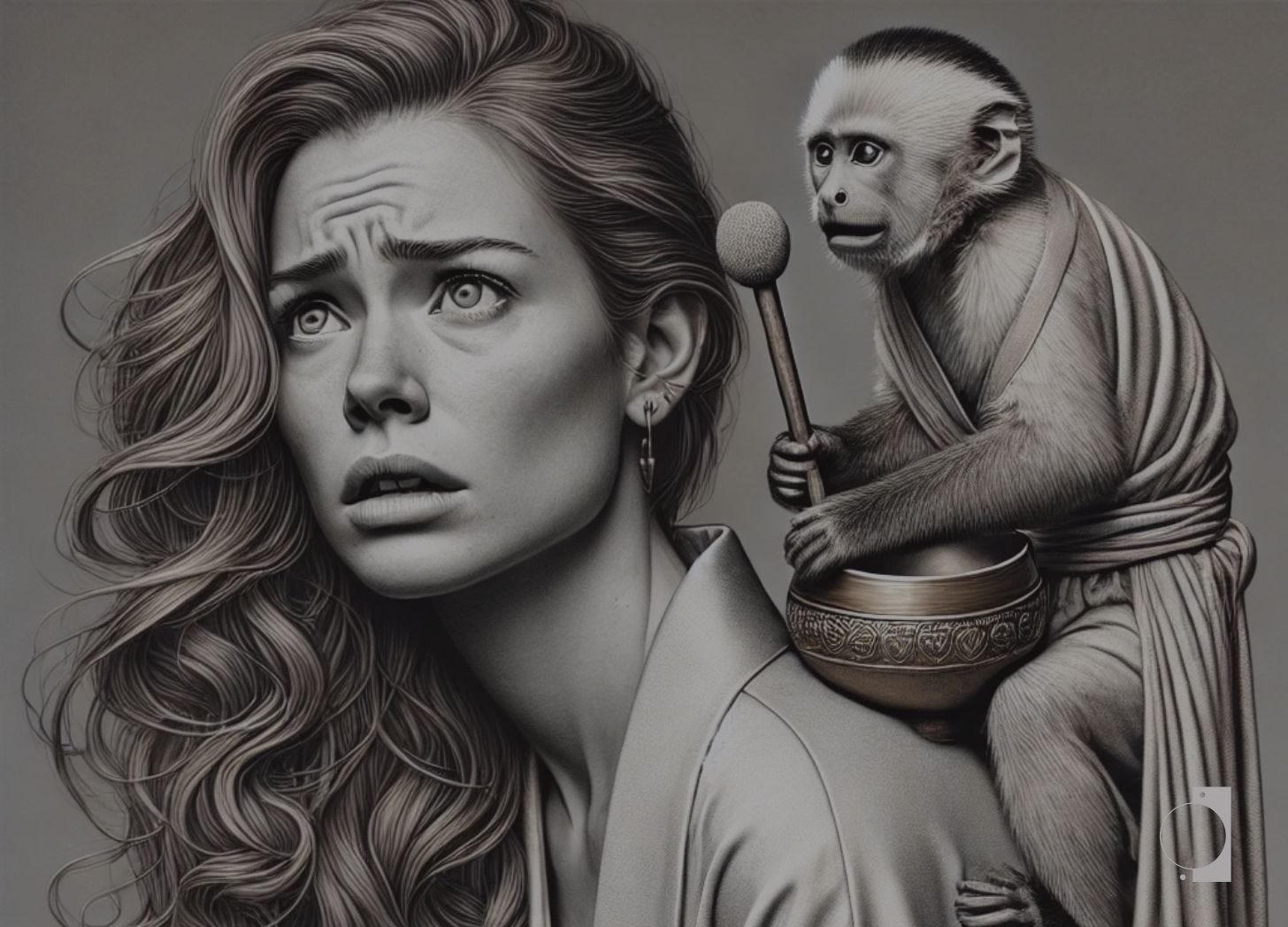
The goal of TM (or any meditation for that matter) is to train our "monkey minds".
The term "monkey mind" is modeled after a Buddhist reference that author Natalie Goldberg references as our "inner critic". Monkey mind are those unconscious thoughts that bubble up during meditation are often those of a critical kind.
You know the ones. They go like this:
… You're not doing this right
… Don't be late picking up the kids again
… You should be working out right now
… Why haven't I gotten a raise yet?
The thoughts that happen to pop up during times of stillness are markers that you may have your own mental monkey.
The personal battle with my mental monkey has been a twelve-year evolution. And while I did not practice TM, the monkey always emerges.
At first I modeled mine after Tony Robbins' method. Performance Coach Tony Robbins approach to meditation is something that he has coined to be "Priming". His process combines small kinetic movements, a moment of gratitude, and 3 things he wants to achieve for the day.
I would actually begin with ten push-ups. Then I was sit cross-legged and continue with a reading from a devotional of mine given to me from my mother. Later I would finish with a prayer. That sequence felt right for me at the time and took 10 minutes from start to finish.
But even then, that damned monkey invaded my thoughts.
Monkey meet-up
Final truth: your monkey doesn't ever leave.
Of course, my monkey shows up when I meditate. But, what I've discovered through having a meditation practice, is that he also makes cameos throughout my day.
He really likes it before big presentations before a large audience. He says something like, "You're going to say something stupid again."
When I look in the mirror during yoga class, he says: "You're not as flexible as the girl beside you."
He especially likes to talk during my backswing when I'm teeing off during a golf event: "Don't miss the ball again."
His tactics are always the same.
He laughs at my insecurities. He's compares me to others. And he lists all of the reasons on why I will never achieve my goals.
The real gift of meditation is, in the stillness, how to recognize my mental monkey's talk from my own.
Since being introduced to my monkey, I have done a lot of work with him.
I have always struggled with my insatiable need for perfectionism - he loves pointing that out. I now recognize my innate fear of abandonment. And I am realizing what is holding me back. The monkey pretty strong, but I'm the one to blame there.
So twelve years later, my meditation practice is streamlined and quite simple.
I typically wake up before the rest of the family. I may empty the dishwasher. I pour myself a tall glass of water. I sit in my favorite chair, in my favorite pajamas while barefoot. I turn on my iPad and watch an 8-10 minute motivational video. Or I may read 10-20 pages of a new book. Once others are up, the chaos resumes full-swing.
Does my monkey get up too?
Of course he does.
But he's sleeping in a little longer now. And, when he's finally up, I know he's all talk anyway.
Your monkey might still be talking.
But you don’t have to keep listening.
Subscribe for more grounded reflections and other tools to help you restore yourself.